96% Faster Schedule Creation with AI Powered BIM Automation
An advanced monitoring solution built to reduce stillborn rates,
protect sow health, and maximize farm productivity.


Client Overview:
A leading MEP consultancy was working on a multi tower commercial development
multiple levels, thousands of pipe routes, and dozens of linked Revit files across
disciplines. The design team had completed coordinated plumbing layouts, but
construction scheduling and fabrication planning were stuck
Their challenge wasn t the design.
It was data extraction.
Every fabrication cycle required:
- Identifying all pipes and fittings from merged Revit models
- Reconciling inconsistent naming conventions
- Mapping materials and sizes
- Manually creating category-based schedules
- Formatting Excel sheets for contractors
A process meant to support construction had become its biggest blocker.
The Challenge:
When the project reached the construction planning phase, the team had to merge plumbing models from two different levels—each built by separate consultants using different family standards.
The result?
And even then, inconsistencies slipped through.
The team needed a way to extract clean, organized, fabrication-ready data—accurately and at scale.
1. 40,000+ elements spread across misaligned models
Manually filtering pipes and fittings became nearly impossible.
2. Inconsistent material & size parameters
What should have been “CPVC32 mm existed under four different naming conventions.
3. Inconsistent fitting types
Reducers, elbows, tees, and
transitions had mismatched
categories, causing schedule
errors.
4. Heavy manual formatting for Excel output
Fabrication teams needed category-sorted, code-driven output—but Revit exports were messy and unusable.
The Solution: Deploying Our AI-Driven Schedule Builder
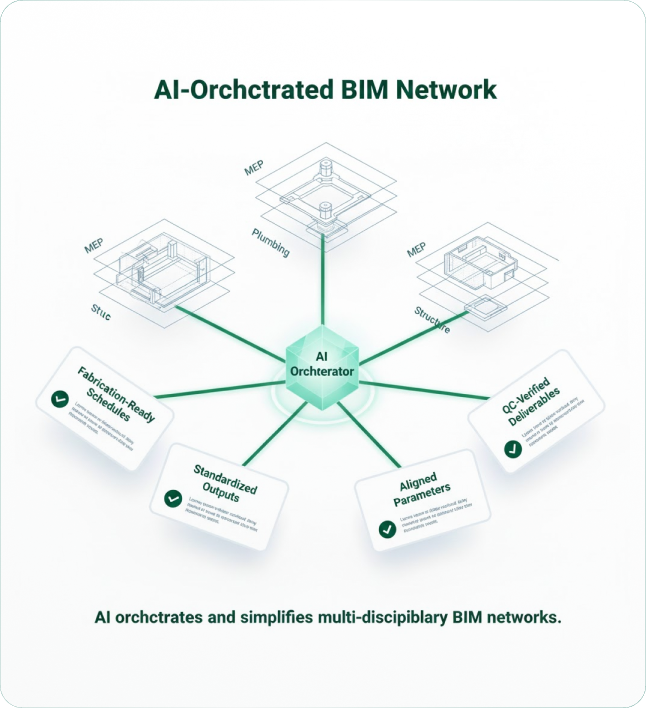
We introduced the client to our AI-powered Schedule Builder, part of our larger BIM Engineering Automation Platform.
Within minutes, the system began solving problems that previously required entire working days.
1. Smart Category Extraction
It scanned all plumbing systems across the merged models and auto-identified:
It scanned all plumbing systems across the merged models and auto-identified:
- Pipes
- Fittings
- Reducers
- Elbows
- Tees
- Connectors
- Transitions
- No manual filtering, no guesswork.
2. Auto-Mapping Materials & Sizes
The AI normalized naming conventions and standardized every material and diameter value—ensuring a single source of truth.
3. Auto Code Generation for Fabrication
Every component received a unique code, instantly aligning with the contractor s internal fabrication system.
4. Automated View Creation & Filtering
The tool generated system-wise and size-wise filters so teams could QA data easily.
5. Excel Export With Zero Manual Clean
Clean, sorted, fabrication-ready Excel files were produced-with all formatting applied automatically.
The Impact: From 2 Days → 30 Minutes
With the Schedule Builder, the team achieved measurable, transformative results
40,000+ pipe & fitting elements extracted and organized automatically
A task previously managed by two engineers over two days.
Fabrication ready schedules generated in under 30 minutes
Reduction in turnaround time: 96%
Zero formatting errors
Clean Excel outputs required no additional rework.
Complete category, size, and material alignment across both models
Eliminated all conflicts caused by inconsistent parameters.
Standardized data for future project phases
The output became a reusable template for further levels and towers.
Client Outcome:
Scheduling Is No Longer a Bottleneck
Once implemented, the BIM Manager noted:
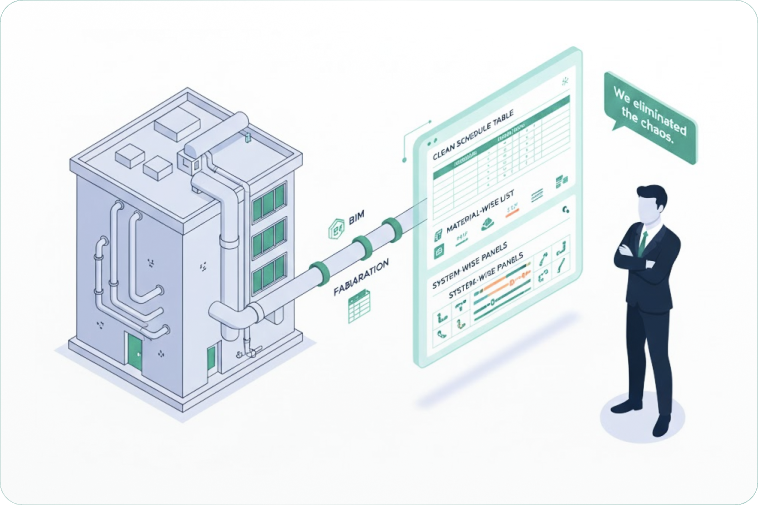
“We didn t just save time-we eliminated the chaos.
For the first time, our schedules matched exactly what
the fabrication team needed.”
The platform is now deployed across multiple ongoing
projects, dramatically accelerating planning cycles and
improving coordination quality.
Why this case matters
Scheduling Is No Longer a Bottleneck
This project demonstrates a larger industry shift.
Complex, multi-disciplinary BIM models are becoming the norm.
Manual scheduling workflows are not.
The AI-driven Schedule Builder represents the next evolution in MEP engineering:
- Automating repetitive tasks
- Standardizing outputs
- Eliminating error-prone manual steps
- Speeding up project delivery
- Creating high-trust data pipelines for fabrication teams
For organizations managing large BIM workloads, this tool isn’t just helpful—
it’s essential for staying competitive.